
How to Become a Nurse Informatics Specialist
A degree may open the door to a variety of opportunities and diverse career paths. The degree programs offered at CTU will not necessarily lead to the featured careers. This collection of articles is intended to help inform and guide you through the process of determining which level of degree and types of certifications align with your desired career path.
As a nursing specialty whose focus is on data utilization and information technology (IT) in the healthcare space, nursing informatics lies at the intersection of clinical nursing practice and technology. As we will see, due to the widespread use of electronic health information systems, nursing informatics has come to play an important role in the quest to improve and enhance the administration of care as well as the overall patient and clinician experience. If you are an RN with an interest in nursing informatics, earning a Bachelor of Science in Nursing (BSN) could help you prepare to pursue opportunities in the field.
Request Information
Select your campus to get started
Estimate Your Costs, Potential Savings and Graduation Date
In this article, we explain what nursing informatics is; explore what nursing informaticists do; provide a step-by-step guide on how to become a nurse informaticist; and discuss the importance of nursing informatics certification and continuing education. By the time you’re through, you should have a better understanding of the nursing informatics specialty and what it takes to pursue a nursing informatics career path.
- What Is Nursing Informatics?
- What Does a Nurse Informaticist Do?
- Step-by-Step: Your Path to a Career in Nursing Informatics
- Nursing Informatics Job Outlook
- Nursing Informatics Continuing Education
What Is Nursing Informatics?
According to the American Nurses Association (ANA), the nursing informatics specialty “transforms data into needed information and leverages technologies to improve health and health care equity, safety, quality and outcomes.”1 Put differently, nursing informatics uses data analysis and data analytics along with information technology to help create a better, more enhanced patient experience and better healthcare practices.
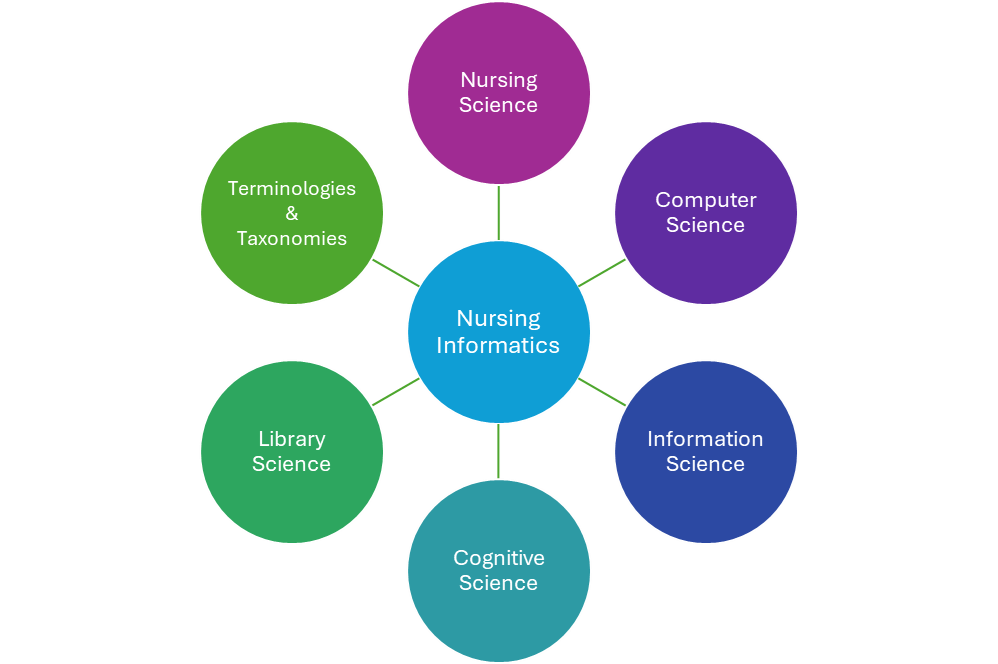
Nursing informatics as an academic discipline pulls from many other areas, including nursing science, computer science, information science, cognitive science, library science, and terminologies and taxonomies.2
What Does a Nurse Informaticist Do?
A nurse informaticist, or informatics nurse, “is a registered nurse with an interest or experience in an informatics field, most often nursing informatics.” A nurse informatics specialist, meanwhile, is an RN “with formal graduate education in informatics” who also has “experience in informatics projects or processes and ha[s] achieved and maintains applicable certifications.”1 (Note: In this article, we refer to these career paths collectively as “nurse informaticists” unless a distinction is needed.)
Nurse informaticists help to design, develop and modify computerized healthcare systems3 (e.g., electronic health records (EHRs) systems). They work with an array of data types, such as clinical data (patient-related data), operational data (administrative/logistical data, such as staffing levels, resource utilization, etc.) and patient-generated data (fitness trackers, mobile apps).4 They analyze the needs of healthcare staff to determine what technological updates are necessary, educate clinical staff on technology use, liaise between the healthcare staff and the IT team, and conduct clinical trial data research.5
Although they work closely with nurses, the focus of informatics nurses and nurse informatics specialists is on the needs of patient groups, not on administering one-on-one patient care.6 They may be employed in an array of different healthcare settings, including hospitals, outpatient clinics, primary care practices, long-term care facilities, home health agencies, government agencies, academic institutions, government agencies and healthcare information technology companies.4
| Traditional Nurse (RN) | Nurse Informaticist | |
|---|---|---|
| Focus | Administering direct patient care | Data analysis/analytics and IT |
| Typical Minimum Educational Attainment | ASN/ADN or BSN7 | BSN or MSN8 |
| Typical Knowledge |
Psychology Customer/Personal Service Medicine Administrative Mathematics Therapy & Counseling9 |
Computers & Electronics Medicine Education & Training Customer & Personal Service Administration & Management6 |
| Examples of Typical Duties |
Assess & observe patient condition Administer treatments & medications Operate medical equipment Perform diagnostic tests9 |
Analyze healthcare staff needs Educate healthcare staff on technology use Liaise between healthcare staff & IT team Research clinical trial data & study informatics5 |
Step-by-Step: Your Path to a Career in Nursing Informatics
Step 1. Become a Registered Nurse (RN)
To become a registered nurse, you must:10
- graduate from an approved nursing program,
- pass a national qualifying exam (i.e., NCLEX-RN examination) and
- satisfy any additional requirements for licensure set by your state’s board of nursing.
An approved nursing program may refer to a nursing diploma program, an associate degree program in nursing (Associate of Science in Nursing (ASN) or Associate Degree in Nursing (ADN)) or a bachelor’s degree program in nursing (Bachelor of Science in Nursing (BSN)).10
Step 2. Earn a Bachelor’s Degree in Nursing (If You Haven’t Already)
Most new RNs who enter practice today hold a bachelor’s or an associate degree in nursing—and many employers have a “strong preference” for new nurses with baccalaureate preparation.11 Meanwhile, informatics nurses likely must hold at least a bachelor’s degree in nursing.12
Registered nurses who hold an ASN or ADN and want to advance their nursing education have the option to pursue an RN-to-BSN degree program. It normally takes around four years to complete a BSN degree program. However, ASN-RNs and ADN-RNs may be able to complete an RN-to-BSN program in two years or less because these programs essentially “pick up” where associate degree in nursing programs leave off.13 Choosing an online RN-to-BSN degree program, like the one at Colorado Technical University (CTU), can provide working RNs the flexibility they need to keep working while in school.
Step 3. Earn a Master’s Degree in Nursing or Informatics
To become a nurse informatics specialist, an RN typically should have a graduate degree in informatics1 (e.g., a master’s degree in nursing informatics) or in nursing. Depending on the institution or master’s degree concentration chosen, an MSN degree program may include courses related to healthcare informatics and technology; healthcare systems; innovation in quality care; and policy and politics in healthcare.
Step 4. Obtain and Maintain Nursing Informatics Certification
While certification is generally considered optional, some employers and some nursing informatics roles require it. There are a few different options when it comes to nursing informatics certification:
- The Nursing Informatics—Board Certified (NI-BC™) credential is offered by the American Nurses Credentialing Center (ANCC). To obtain NI-BC certification, an RN must pass the ANCC Informatics Nursing board certification examination, a competency-based exam that assesses entry-level clinical knowledge and skills in the informatics specialty. Certification must be renewed every five years.14
- The Certified Associate in Healthcare Information and Management Systems (CAHIMS®) credential is offered by the Healthcare Information and Management Systems Society (HIMSS). It is geared toward early careerists and solutions providers who are involved in planning, implementing and optimizing health technology. The exam covers a range of healthcare information management topics, including systems analysis, clinical informatics and project management. Certification must be renewed every three years.15
- The HIMSS Certified Professional in Healthcare Information and Management Systems (CPHIMS®) credential is designed for mid-career digital health professionals. It signifies that an individual is competent to manage health innovation projects and new technology systems roll outs. Certification must be renewed every three years.16
- The HIMSS Certified Professional in Digital Health Transformation Strategy (CPDHTS®) credential is designed for experienced health experts. The credential signifies the ability to lead health innovation projects and strategy development for digital health transformation projects. Certification must be renewed every two years.17
Nursing Informatics Job Outlook
Because the Bureau of Labor Statistics (BLS) does not provide employment projection data for nurse informaticists, nurse informatics or health informatics specialists specifically, the Department of Labor uses computer systems analysts as a proxy. Employment of computer systems analysts is projected to grow 9% between 2024 and 2034,6 which is higher than the average projected growth of 3% for all occupations.18
Nursing Informatics Continuing Education
Continuing education plays an important role not only in nursing in general but also in the nursing informatics field. Continuing education courses are a way to ensure that RNs keep their knowledge current, and they may be required by states, certifying bodies or employers. Following initial licensure, most states require RNs to complete a certain number of continuing education units (CEUs) every two to three years.19
But continuing education also plays a role in nursing informatics certification maintenance and renewal: ANCC certification renewal requirements include mandatory completion—within a designated five-year certification period and prior to renewal application submission—of 75 continuing education contact hours and of at least one of eight certification renewal professional development categories in its entirety.20 HIMSS certification renewal requirements give individuals the option to retake the certification exam or complete a certain number of continuing education hours.21 Complete renewal requirements can be found on their respective websites.
Start Your Journey at Colorado Technical University
The accredited online nursing degree programs at CTU were developed by experienced nurse educators and are designed for working nurses. Our Bachelor of Science in Nursing (BSN), Master of Science in Nursing (MSN) (with concentration options in Family Nurse Practitioner, Nursing Administration and Nursing Education) and Doctor of Nursing Practice (DNP) online degree programs offer RNs the flexibility needed to pursue their academic goals while juggling long or irregular nursing shifts as well as family or personal obligations. We also offer a Post-Graduate Family Nurse Practitioner (FNP) Certificate program.
The Bachelor of Science in Nursing degree, Master of Science in Nursing degree, Post-Graduate APRN Certificate—Family Nurse Practitioner, and Doctor of Nursing Practice degree programs at Colorado Technical University are accredited by the Commission on Collegiate Nursing Education ( http://www.ccneaccreditation.org).
Explore CTU’s full range of online nursing degree programs today, or apply now.
CTU cannot guarantee employment, salary, or career advancement. Not all programs are available to residents of all states. REQ2206480 03/2026
1 American Nurses Association (ANA), “The Scope of Nursing Informatics Practice,” Nursing Informatics: Scope and Standards of Practice (3rd ed. 2022), https://www.nursingworld.org/nurses-books/nursing-informatics-scope-and-standards-of-practi/.
2 Tiffany Kelley, PhD, MBA, RN-BC, “Informatics: An Essential Nursing Career,” American Nurse (July 10, 2023), https://www.myamericannurse.com/informatics-an-essential-nursing-career/. (visited 3/25/2026).
3 National Center for O*NET Development, O*Net Online, “15-1211.01—Health Informatics Specialists,” https://www.onetonline.org/link/summary/15-1211.01 (last visited Mar. 25, 2026).
4 Nurse.com, “Understanding the Role of an Informatics Nurse” (updated Jan. 16, 2026), https://www.nurse.com/nursing-resources/nursing-informatics-resources/role-of-informatics-nurses-in-healthcare/.
5 Johnson & Johnson Nursing, “Informatics Nurse,” https://nursing.jnj.com/specialty/informatics-nurse (last visited Mar. 16, 2026).
6 U.S. Department of Labor, Career One Stop, “Occupation Profile for Health Informatics Specialists,” https://www.careeronestop.org/Toolkit/Careers/Occupations/occupation-profile.aspx?keyword=Health%20Informatics%20Specialists&location=29576&onetcode=15121101 (last visited Mar. 25, 2026).
7 Bureau of Labor Statistics, U.S. Department of Labor, Occupational Outlook Handbook, “Registered Nurses,” https://www.bls.gov/ooh/healthcare/registered-nurses.htm (last visited Mar. 25, 2026).
8 American Nurses Association (ANA), ANA Nursing Resources Hub, “What Is Nursing Informatics?” (July 5, 2023), https://www.nursingworld.org/content-hub/resources/nursing-resources/nursing-informatics/.
9 U.S. Department of Labor, Career One Stop, “Occupation Profile for Registered Nurses,” https://www.careeronestop.org/Toolkit/Careers/Occupations/occupation-profile.aspx?&keyword=Registered%20Nurses&location=US&onetcode=29-1141.00 (last visited Mar. 25, 2026).
10 Bureau of Labor Statistics, U.S. Department of Labor, Occupational Outlook Handbook, “Registered Nurses,” at https://www.bls.gov/ooh/healthcare/registered-nurses.htm (last visited Mar. 25, 2026).
11 American Association of Colleges of Nursing (AACN), “Nursing Workforce Fact Sheet” (Apr. 2024) https://www.aacnnursing.org/news-data/fact-sheets/nursing-workforce-fact-sheet.
12 Nursing License Map, “How to Become an Informatics Nurse Specialist—Career Guide,” https://nursinglicensemap.com/nursing-specialties/registered-nurse/informatics-nurse/ (last visited Mar. 25, 2026).
13 American Nurses Association (ANA), ANA Nursing Resources Hub, “RN to BSN: Advancing Your Nursing Career” (Feb. 9, 2024), https://www.nursingworld.org/content-hub/resources/nursing-resources/rn-to-bsn/.
14 American Nurses Credentialling Center, “Informatics Nursing Certification (NI-BC™),” https://www.nursingworld.org/our-certifications/informatics-nurse/ (last visited Mar. 25, 2026).
15 Healthcare Information and Management Systems Society (HIMSS), “CAHIMS: Certified Associate in Healthcare Information & Management Systems,” https://www.himss.org/certifications/cahims/ (last visited Mar. 25, 2026).
16 Healthcare Information and Management Systems Society (HIMSS), “CPHIMS: Certified Professional in Healthcare Information & Management Systems,” https://www.himss.org/certifications/cphims/ (last visited Mar. 25, 2026).
17 Healthcare Information and Management Systems Society (HIMSS), “CPDHTS: Certified Professional in Digital Health Transformation Strategy,” https://www.himss.org/certifications/cpdhts/ (last visited Mar. 25, 2026).
18 Bureau of Labor Statistics, U.S. Department of Labor, Occupational Outlook Handbook, “Computer Systems Analysts,” https://www.bls.gov/ooh/computer-and-information-technology/computer-systems-analysts.htm (last visited Mar. 25, 2026). This data represents national figures and is not based on school-specific information. Conditions in your area may vary.
19 Sarah Jividen, RN, BSN, “Nursing Continuing Education (CE) Requirements by State,” Nurse.org (Feb. 3, 2025), https://nurse.org/resources/continuing-education/.
20 “ANCC Certification Renewal Handbook” (effective date: Sep. 10, 2025, Version 2: Feb. 10, 2026), https://www.nursingworld.org/certification/renewals/.
21 Healthcare Information and Management Systems Society (HIMSS), “Recertification,” https://www.himss.org/certifications/recertification/ (last visited Mar. 25, 2026).